hipobuy Tennis Racket Spreadsheet Guide
hipobuy Tennis Racket Spreadsheet Guide
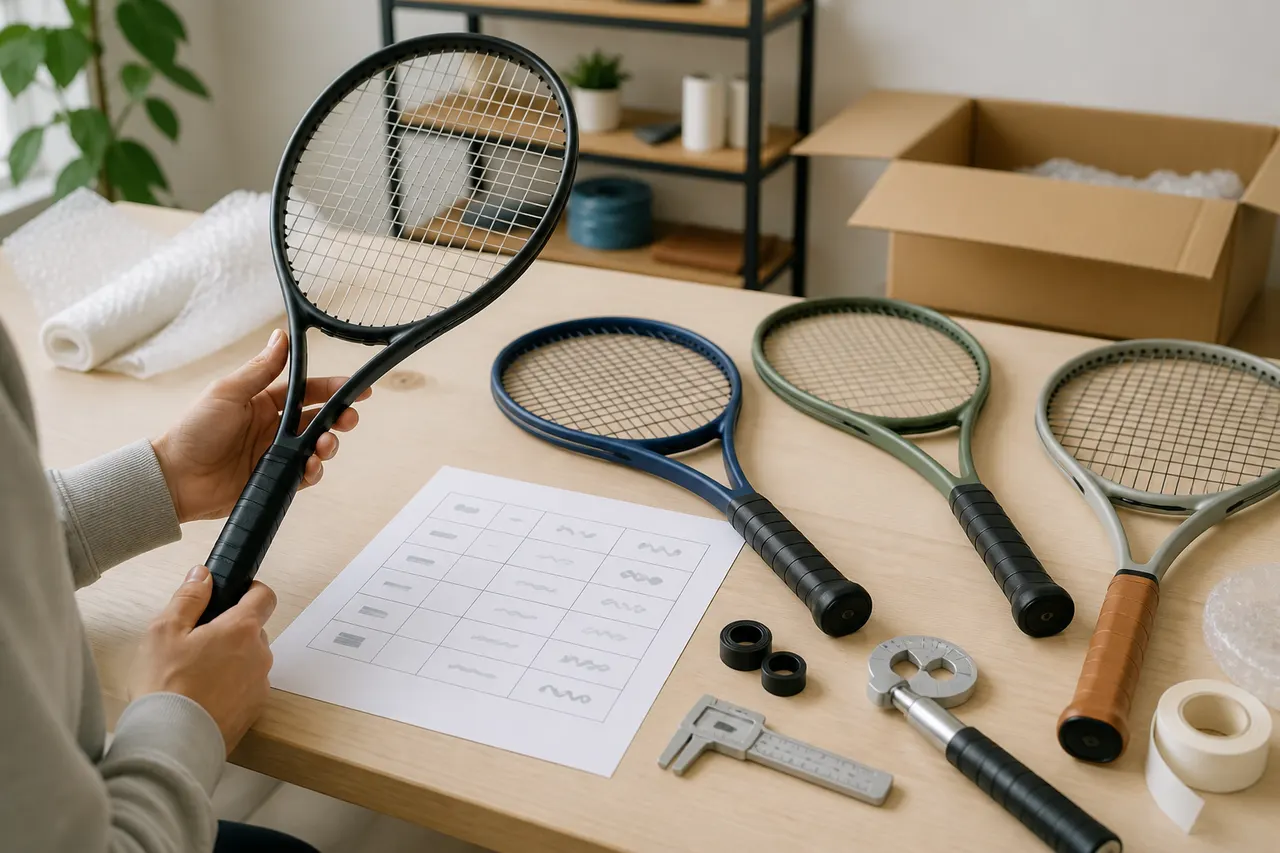
A tennis racket spreadsheet is not meant to pick the "best" racket for you. It is meant to organize scattered product information into a checklist you can verify, sort, and eliminate candidates from. This guide is for buyers who are browsing hipo-buy.org for tennis rackets but have not yet decided on head size, weight, balance, or grip size.
After reading, you should keep one primary choice and one backup choice with complete specifications, and list questions to confirm with the seller or platform before ordering. If a product page lacks basic information such as model, weight, or grip size, or if you need professional stringing, injury adaptation, or certified competitive equipment, this guide cannot replace the brand's specification page, a coach's advice, or an in-person trial.
First, clarify your level, stroke habits, and frequency of play
Do not start with brand, color, or lowest price. First, record your usage scenario to avoid mixing up seemingly similar rackets in the spreadsheet.
Start by answering these questions:
Are you learning a full swing for the first time, or can you already rally consistently?
Do you mainly play from the baseline, at the net, or both?
Is your swing short and compact, or longer and faster?
Do you play occasionally each month, or train multiple times a week?
Do you experience discomfort in your wrist, elbow, or shoulder?
Can you find a racket with similar specs locally to test grip or swing?
Beginners usually need candidates that make it easy to hit the sweet spot and have a manageable swing feel. Advanced players who can generate racket head speed can further compare stability, control orientation, and swing weight. "Beginner" or "advanced" labels are only a starting point for filtering and cannot determine the model on their own.
If you have persistent pain, old injuries, or rehabilitation needs, stop selecting a racket based solely on the spreadsheet and consult a qualified medical professional or a certified coach. Racket parameters can help rule out obviously unsuitable products, but they cannot diagnose or solve injuries.
What a hipobuy spreadsheet can provide and what it cannot prove
In the context of hipo-buy.org, a spreadsheet is best used as a product discovery and initial screening tool. It can centrally record titles, listed specs, seller options, image status, and questions to confirm, reducing the need to switch back and forth between multiple candidate pages. 🔎
It cannot independently prove the following:
The product is definitely an authentic brand item.
The listed weight is the actual weight after stringing.
Stock, price, promotions, or shipping routes are still valid.
The frame's internal structure, material grade, and official model match completely.
The images correspond to the exact item that will be shipped.
The racket suits your joint condition or technique.
Prices, stock, specs, shipping, taxes, and return conditions may change. Since no verifiable sample product was provided, this article does not list current prices, stock, or route conclusions. Before actually ordering, recheck the corresponding page on hipo-buy.org and record the verification date in the spreadsheet; any fields that cannot be confirmed should be marked as "unknown" rather than guessed.
It is recommended to create at least these columns: product title, original product identifier, model text, head size, length, unstrung weight, balance, grip size, stringing status, seller options, QC pending items, page verification date, and reason for elimination. If the product identifier is unclear or the link is broken, do not proceed with an order based solely on screenshots.
Build a candidate list based on head size, length, and weight information
The first round of comparison should only use specs clearly written on the page, not assumptions from appearance. If the title and spec options contradict each other, put the item in "to be confirmed" rather than picking the number that seems more reasonable.
Filter field | What to record | What to do if information is missing |
|---|---|---|
Head size | Square inches or square centimeters, with original unit | Do not estimate from photo proportions |
Length | Listed total length | Do not assume all rackets are standard length |
Weight | Value, unit, and strung or unstrung status | Do not compare directly if status is unknown |
Balance | mm, cm, or head light, even, head heavy description | Do not judge from hand-held photos |
Grip | Size code and corresponding option text | If no size is given, treat as a blocking issue before ordering |
A larger head usually means a more forgiving hitting area, but actual performance is also affected by frame structure, string pattern, and swing weight. A smaller head does not automatically mean "professional" or "better control." Increased length may change reach and swing feel, but it may also increase maneuverability burden.
Weight comparison is especially error-prone. The same number could represent a bare frame, an unstrung racket, or a strung racket, and grip wraps, dampeners, and protective tape can change the actual weight. The spreadsheet should split "value" and "measurement status" into two columns; only records with consistent definitions should be sorted. 🎾
For the first round of filtering, you can proceed as follows:
Remove pages that do not clearly have tennis racket attributes, only decorative images, or unidentifiable specific options.
Put items with documented head size, length, and weight into the candidate area.
Convert values with different units to a common unit, while keeping the original record.
Add confirmation tasks for items with unknown stringing status or conflicting title and options.
Do not ignore missing fields just because the price is low; insufficient information is itself a risk.
Determine balance and frame orientation based on swing style
Static weight alone does not fully describe the swing feel. Two rackets with similar weight but different balance and weight distribution can feel noticeably different when starting the swing, accelerating, or volleying. Swing weight, which truly describes dynamic swing burden, is often not listed on ordinary product pages, so static weight cannot substitute for swing weight.
Buyers with short swings who rely on the racket to help with depth can look for sweet spot forgiveness and stability, but do not treat "head heavy" as a guarantee of effortless power. Buyers with longer swings who can actively accelerate may want to exclude candidates whose head is hard to bring through in time. If you often play at the net or need quick reactions, maneuverability should be a separate judgment factor.
Frame width, stiffness, and structure should not be precisely inferred from product images without reliable text descriptions. If the page includes promotional words like "control-oriented" or "power-oriented," record them as seller descriptions, not verified performance results.
It is recommended to assign one of three statuses to candidates:
Keep: Specs are complete and direction matches your swing habits.
To be confirmed: Key parameters are missing, but other conditions still warrant verification.
Eliminate: Size is clearly unsuitable, conflicting information cannot be resolved, or risk exceeds acceptable range.
This approach is more reliable than calculating an unsupported composite score for each racket.
Grip size and hand fit check method
Grip size cannot be determined solely by height, gender, or hand photos. The most reliable method is to hold a racket of known size locally and use it as a reference. If choosing remotely, use the brand's official measurement method and confirm which numbering system the product options use.
Common markings may include L0 to L5, inch circumference, or regional size names, but the conversion text on different pages may be wrong. Do not assume that the same number means the same size; record the original text, unit, and the specification reference.
When testing a similar size, check:
Do you need excessive grip pressure to stabilize the racket in a forehand grip?
Do your fingers press hard into your palm?
Is switching between forehand and backhand grips smooth?
Does your forearm get tense quickly after repeated shadow swings?
After adding an overgrip, is the circumference change still acceptable?
If you are between two sizes, do not treat "I can add an overgrip later" as a universal fix. Adding thickness can change grip bevels, feel, and final weight; a larger base handle is also not easily reduced without damage. If you cannot test, prioritize candidates with clear return policies and complete size information. 📏
Tennis racket product page and QC photo checklist
Product page review and QC review serve different purposes. The product page confirms what you have selected; QC photos check whether the item actually received in the warehouse matches your order selection within visible range. QC photos cannot prove internal frame materials, long-term durability, or hitting performance.
When viewing the product page, record:
Does the title and spec options clearly refer to a tennis racket, not a cover, children's toy racket, or separate accessory?
Is the listing for a single racket, a pair, or a set with balls, cover, etc.?
Are color, model, grip size, and stringing options separately selectable?
Does the weight note specify strung or unstrung status and allowable tolerance?
Are there obvious conflicts between page images and text parameters?
Does the seller state return limitations, custom stringing handling, or out-of-stock substitution?
When viewing QC photos, at least check:
Are the full front and back of the racket, the side of the frame, and the butt cap visible?
Are there any cracks, significant dents, severe paint chips, or abnormal deformation on the frame?
Are grommets, bumper guard, and areas near string holes visibly damaged?
Does the grip size marking, color, and model text match the selected option?
For strung rackets, are there obvious broken strings, severe misalignment, or visibly uneven string bed?
Is the promised cover or accessories present in the packaging?
If the photo angles are insufficient, request additional photos that address specific doubts rather than a generic "take clearer pictures." For example, ask for a close-up of the butt cap size marking or the 3 o'clock position of the frame. If visible defects affect structural safety, do not ignore the risk for the sake of later retouching, verbal promises, or low-price compensation. 📷
Stringing, shipping protection, and additional cost boundaries
Stringing status affects usability upon arrival, weight, and subsequent costs. If the page says "strung," still confirm whether string type, tension, and stringing method can be chosen; if not clearly noted, do not assume the seller will string according to your preferences.
For high tension, special strings, or personalized stringing, remote customization may increase communication errors and return/exchange difficulty. A more conservative approach is to compare the total cost of an unstrung racket plus local stringing after arrival, while also considering whether local stringing services are available. Any tension recommendation should be based on the specific racket's allowable range, string documentation, and a professional stringer's advice.
Tennis rackets are long and their frames are easily compressed. Before shipping, confirm the packaging options available from the warehouse and the actual billing rules, and ask whether the head, frame, and grip can be protected. Do not infer specific materials or compression resistance just from the words "reinforced packaging."
Possible costs include product price, domestic shipping, inspection or value-added services, packaging materials, international shipping, payment-related fees, and possible taxes at destination. Specific items and amounts must be based on the checkout page, route rules, and destination customs information, and the verification date should be recorded.
Combined shipping is not necessarily cheaper. Combining a tennis racket with a shoe box or other large items may reduce repeated fixed fees, but it may also increase outer box size, volumetric weight, and risk of loss in a single shipment. Separate shipping may increase fixed fees but can prevent other items from squeezing the racket frame. Without actual package dimensions, billable weight, and route rules, no single answer can be given. 📦
For customs clearance, provide the required documents and product information truthfully. Do not request under-declaration, false declaration, or splitting orders to evade taxes and inspections. If the destination country has special regulations on materials, branded goods, or sporting goods, follow the current requirements of local customs and the carrier route.
Final action: keep one primary and one backup
After filtering, you do not need to keep a dozen rackets "to look at later." Narrow the list to one primary and one backup, and keep traceable reasons for both.
The primary should satisfy:
Head size, length, weight status, and grip size information are sufficiently complete.
Parameter direction has no obvious conflict with your level and swing style.
Product options, accessory scope, and stringing status can be confirmed.
There is an executable inspection method for the QC stage.
Packaging, shipping, and return risks are within your budget.
The backup should not just be a cheaper similar-looking item. It should be able to fulfill the same use case if the primary is out of stock, specs cannot be confirmed, or QC fails. If both candidates lack key parameters, keep searching rather than choosing between unknown risks.
Perform a final check before ordering: open the product page, confirm the link is still valid; recheck the selected specs, current price, stock notice, and service conditions; record the date; save the option text; list QC blocking items. After receiving QC, decide whether to accept, request additional photos, apply for processing, or cancel shipping according to the checklist.
This method may not save a predetermined amount, but it can save costs caused by wrong size, repeated stringing, reshipment, and unsuitable shipping plans. Since there is no sample price or shipping cost for specific candidates, it would be dishonest to give a fixed savings figure. The added cost is the time spent filtering and verifying, and it cannot eliminate risks such as seller information errors, shipping damage, tax changes, and the inability to test swing remotely.
It is more suitable for buyers who are willing to record specs, can wait for QC, and accept the uncertainty of cross-border shopping. It is not recommended for those who urgently need a match racket, must match swing weight precisely, need injury adaptation, or cannot bear return/exchange limitations. The final decision should be based on verifiable parameters and clear risk boundaries, not on spreadsheet rankings, promotional words, or a single product image. ✅
FAQ for agent platform shopping
1. On hipo-buy.org, what is the best way to locate an item I want to buy?
You may either enter a single search term or navigate straight to a category page where items are additionally grouped by brand. Compared with shorter search phrases, longer ones usually produce fewer hits but offer greater accuracy. For instance, you could look up "Air Force 1 White," "sneakers," or just "Air Force 1."
2. For hipo-buy.org users, which platform has the best coupon deal?
Kakobuy is my suggestion because right now it provides a $15 discount code with no minimum spend required. This works well for customers who ship small parcels. Use the promo code kakobuy888.
3. How can I tell if a product on hipo-buy.org is of good quality?
Look over the QC photos to evaluate quality—factory images alone are not enough since they are usually edited. Use the QC photos to check whether the product satisfies your detail requirements before you commit to buying it.
Also remember to steer clear of very low-priced items, as they tend to be poor quality.
4. What are QC photos, and how do they work on hipo-buy.org?
Every drop-shipping service, including hipo-buy.org, has its own quality control specialists. When your items reach the platform's warehouse, they perform a quality check and photograph your products. Typically three photos are taken, and the staff confirms that the color, size, specifications, and quantity match your order. They also look for any defects. Electronic products are an exception, as only their external appearance is checked. If defects or wrong size/color are found, the team promptly asks the seller for a return. This helps ensure the products you receive are of high quality.
Browse our latest products and find your next favorite item.